
Trigger warning: this piece describes extreme training, severe calorie restriction, and sleep deprivation. It’s intended to inform, not to glamorize self-harm or reckless behavior.

David Goggins is famous for extremes. Former Air Force recruit turned Navy SEAL, ultramarathoner and author of Can’t Hurt Me, Goggins’ story of losing 100+ pounds and forcing himself into SEAL training became the stuff of legend. He’s also built a brand on relentless mental toughness and “embrace the suck” discipline. That intensity is inspirational — but it’s also dangerous if copied without decades of conditioning, medical oversight, and realistic expectations.
Below I break down what Goggins’ military preparation actually looked like (training, daily routine, and how he ate during the big weight-loss push), compare it with current sports medicine research and expert criticism, and explain clearly why I do not recommend most people try to replicate this. Where public records are thin, I make careful, evidence-based inferences and flag them as such.
Quick facts you should know up front
- Goggins has repeatedly described dramatic weight loss (roughly 100+ pounds) in a short period while preparing for SEAL training. Reporting and his own accounts indicate extreme calorie restriction paired with very high exercise volume. (Men’s Health)
- His training centered on very high cardiovascular volume (running, rucking, cycling, swimming), and very high-rep calisthenics (hundreds of reps daily, many pull-ups/push-ups). He also emphasizes hard mental training. (The Singju Post)
- Exercise scientists and coaches caution that his style—high repetition, relentless volume, minimal recovery—raises real risks: overuse injuries, hormonal disruption, immune suppression, and burnout. (Fitness Volt)

1) What Goggins actually did while preparing for the SEALs
The weight-loss phase
Goggins’ most circulated story: he tipped the scales near 297 lb and needed to lose weight fast to make military screening. Multiple accounts — including his own interviews and media write-ups — report he lost roughly 100+ pounds in a very short window (often reported as ~3 months), combining severe calorie restriction with enormous daily activity. Journalists and experimenters who tested his day-to-day described diets that were hypocaloric (some descriptions reference eating under 1,000 calories on intense training days), paired with many hours of running/cycling and calisthenics. (Men’s Health)
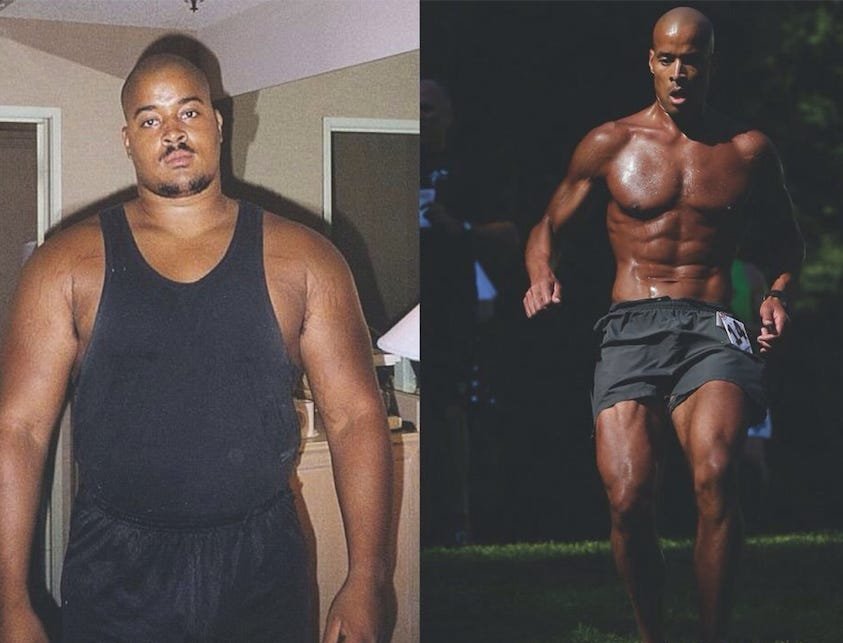
Important caveat: public retellings vary on exact calorie totals and timeline; Goggins’ own retellings emphasize willpower and volume more than giving a strict macro breakdown. Where reporting conflicts, it is safest to say he used very low calories + very high output to get rapid weight loss, which current guidelines would generally call unsafe without medical supervision. (Men’s Health)
Training volume & structure
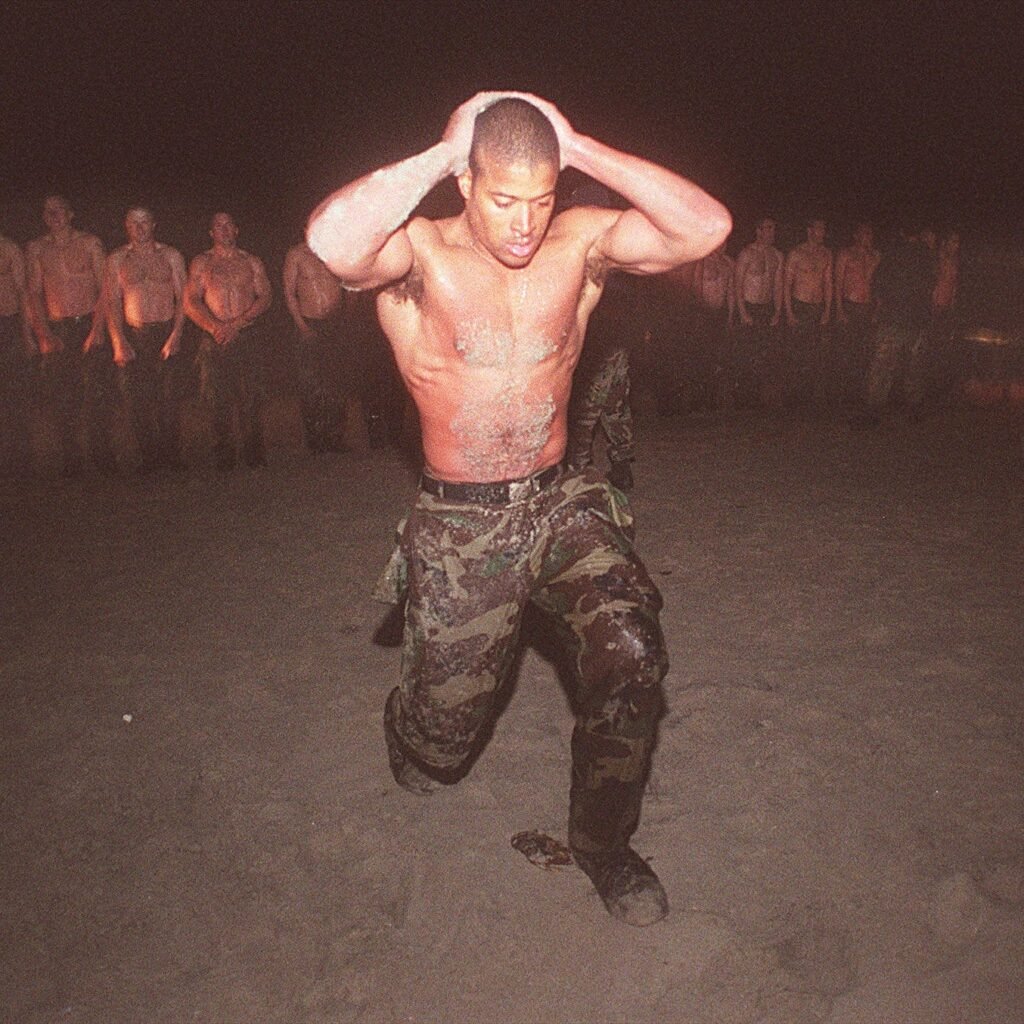
From interviews and public appearances (including his Joe Rogan interview and many podcasts), the consistent picture is:
- High mileage running — early morning runs and multiple runs per day during intense phases. He has described daily runs in the double-digit miles on many days. (The Singju Post)
- Rucking and swimming — weighted marches and swims to simulate SEAL demands. (The Singju Post)
- High-rep calisthenics — pull-ups, push-ups, sit-ups, squats in very large volumes; Goggins later performed extreme feats (e.g., thousands of pull-ups for record attempts), which reflect a long-term adaptation to high volume. (The Singju Post)
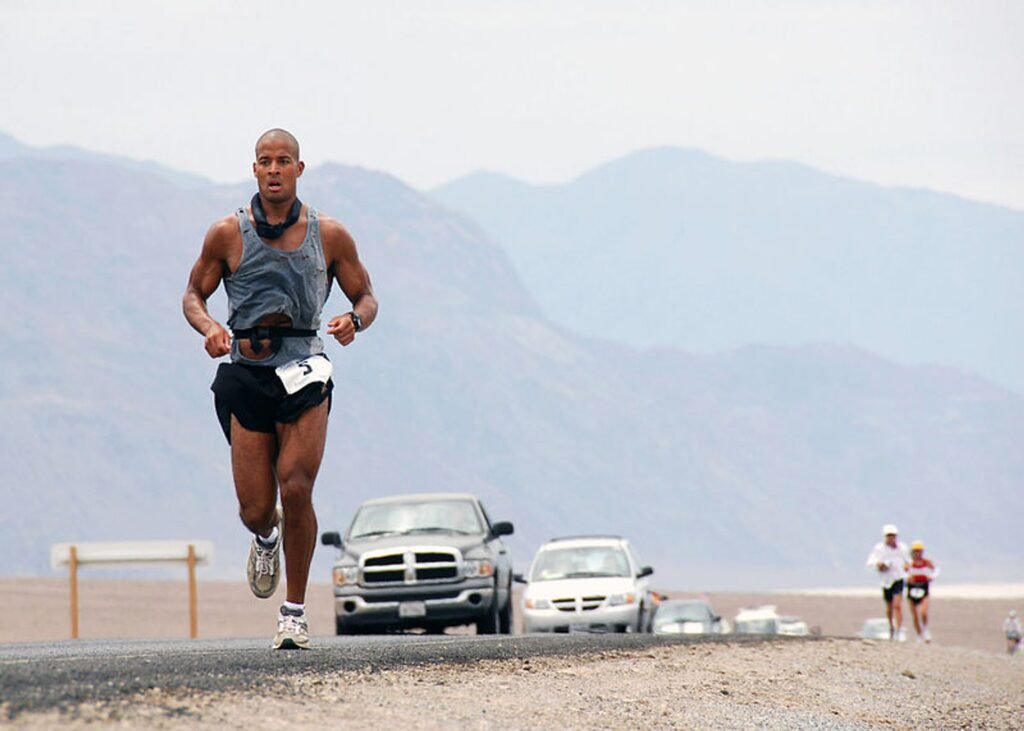
He layered multiple sessions per day, sometimes training before sunrise and again later. Sleep was often deprioritized during the most intense push.
Recovery (or the minimal version of it)
Goggins is explicit: he deliberately exposed himself to discomfort to “callus the mind.” That meant many days with little formal rest, active recovery only, and limited sleep during peak blocks. This is part of the mythos — but it’s also the part that most experts flag as risky. (The Singju Post)
2) How he ate (and how that changed later)
The rapid weight-loss diet
Accounts from journalists and people who attempted his diet describe very low calorie days (estimates vary; some tested it around ~800–1,000 kcal while maintaining massive activity) with simple, low-fat, low-sugar meals, focusing on lean proteins and small portions of carbs. One piece that tested a day of the diet called it effectively an extremely restrictive approach that’s not sustainable for most people. (Men’s Health)
What Goggins himself emphasizes: a focus on whole, simple foods during training phases, plus eating to fuel performance once he became an endurance athlete. In other periods he has spoken about intermittent fasting and keeping protein frequent across meals, but his public statements are more about discipline and fuel than about a strict, named diet. (RoutineBase)
Later / maintenance nutrition
As Goggins moved into ultrarunning and long endurance events, nutrition shifted to maintenance and fueling: higher carbohydrates for long sessions, continued emphasis on protein and whole foods, attention to hydration and electrolytes. That’s consistent with typical endurance fueling needs: once volume increases chronically, caloric and carbohydrate intake must increase to preserve performance and health. Where sources about Goggins’ exact macros conflict, the safer summary is “extremely low calories during the rapid-loss phase; strategic, performance-oriented fueling later.” (RoutineBase)
3) What the research and experts say (the realistic risks)
You can be inspired by Goggins’ mental toughness — but don’t confuse inspiration with safe programming. Sports medicine and exercise physiology make two key points:
Overuse and overtraining are real medical problems
Repeated very high mileage, very high rep volumes, and inadequate recovery increase risk of stress fractures, tendinopathies, and overtraining syndrome. Overtraining can manifest as chronic fatigue, depressed mood, persistent injuries, infections (immune suppression), and hormonal disturbances (cortisol/testosterone imbalance). Recent reviews and medical overviews underscore these risks in athletes who chronically train at excessive volumes without adequate rest or nutrition. (PMC)
Sleep and caloric deficit compound the danger
Chronic sleep deprivation (regularly getting ≤5–6 hours while training intensely) worsens hormonal dysregulation, recovery, and immune function. Severe calorie restriction while doing thousands of calories of work daily risks muscle loss, metabolic slowdown, and in extreme cases acute events (electrolyte imbalance, acute kidney injury with endurance events). Medical commentaries on marathon physiology and overtraining note the acute inflammatory and kidney stresses that can accompany extreme endurance efforts. (SpringerOpen)
What experienced coaches say
Exercise scientists who have reviewed Goggins’ workouts commonly say: his approach is a mental model (pushing beyond perceived limits) but not a physical training model for most people. High-rep calisthenics and relentless volume can be useful in controlled, progressive doses — but Goggins’ extreme case is not the way to prescribe training for most gym-goers or athletes aiming for longevity. See critiques by sports scientists and trainers who warn against copying volume and rep counts blindly. (Fitness Volt)
4) Real-life critiques and controversies (what people are saying)
- Some trainers praise his mental toughness, saying Goggins is a master of discipline and has useful messages about accountability and consistency. His story is motivational for many. (The Singju Post)
- Many exercise scientists and coaches push back: they say Goggins’ training is neither optimized nor safe for most trainees. Examples include public critiques that call out extreme repetition, minimal recovery, and the risk of promoting toxic “no-pain, no-gain” thinking. (Fitness Volt)
- Social commentary: some readers and forum posters praise his toughness; others say the mythologizing of extreme suffering can encourage people to ignore injury signals and try to emulate him without the required foundation. (Reddit)
5) Bottom line: Why you should not copy Goggins’ prep as written
- Rapid weight loss via extreme deficit is unsafe. Most safe guidelines aim for ~0.5–2 lb/week depending on context; losing 100 lb in a few months involves severe physiology trade-offs (muscle loss, hormonal disruption, nutrient deficiencies). Replicating that without medical supervision is risky. (Men’s Health)
- High-volume, high-rep training without progressive build and recovery invites injury. Stress fractures, tendinopathies, and rhabdomyolysis are known risks with extreme volume. Sports medicine literature documents these hazards. (PMC)
- Sleep deprivation and constant cortisol elevation are not performance hacks. They slowly erode recovery and performance and increase illness risk. Medical reviews on overtraining and sleep emphasize that recovery is where adaptation happens. (PMC)
- The mental toughness message can be misread. There’s a difference between pushing discomfort and ignoring real injury. “Suffering” as discipline is useful in moderation; glorifying persistent pain and ignoring medical signals is not. Many coaches explicitly state Goggins’ mental model should be adapted, not copied. (Fitness Volt)
6) What you can take from Goggins — safely
- Adopt the habit/discipline mindset, not the extremes. Use his “callous the mind” idea to build small, timed exposures to discomfort: a cold shower, a 5 a.m. run once a week, a hard but short interval session — not daily torture. (The Singju Post)
- Progressive overload > reckless volume. If you want pull-ups, add 1–2 reps per week or use assisted variations — not hundreds on day one. Exercise science still supports gradual, progressive stress. (Fitness Volt)
- Prioritize sleep and nutrition. Modern evidence is clear: adaptation happens with rest and adequate fuel. If you want sustainable gains, start with balanced calories and nightly sleep that allows recovery. (UCLA Health)
- Have measurable, realistic goals. A testable, time-bounded aim (e.g., add 10 min of running endurance in 8 weeks) is better than “become unbreakable” overnight.
7) A “Goggins-inspired but safe” 8-week starter plan (example)
Goal: build consistency and mental grit without risking overuse.
- Weeks 1–2: 3×/week moderate cardio (20–30 min), 2×/week strength (bodyweight + light load), daily mobility 5–10 min, target 7+ hours sleep most nights.
- Weeks 3–4: Increase one cardio session to 40–45 min, add progression to strength (extra set or reps), include one “hard” interval session per week. Practice one “mental challenge” per week (cold shower, early alarm).
- Weeks 5–8: Add a long session once per week (long run/walk 60–90 min), maintain 2 strength sessions, schedule a deload week in week 7 (reduce volume 30%). Track sleep, mood, and soreness; back off if persistent pain appears.

This plan borrows the disciplined daily habit idea from Goggins but keeps recovery and progressive overload central. You can follow David Goggins on Instagram here.
Conclusion: Respect the story — don’t copy the prescription
David Goggins is a valuable story: a man who used relentless discipline to transform his life. But his training and nutrition for SEAL prep were extraordinary and context-specific: severe calorie deficits, huge weekly training loads, and intentional discomfort that he himself frames as survival-grade effort. Sports medicine and exercise experts repeatedly caution that copying his regimen is risky without years of conditioning and medical oversight. (The Singju Post)